


Description
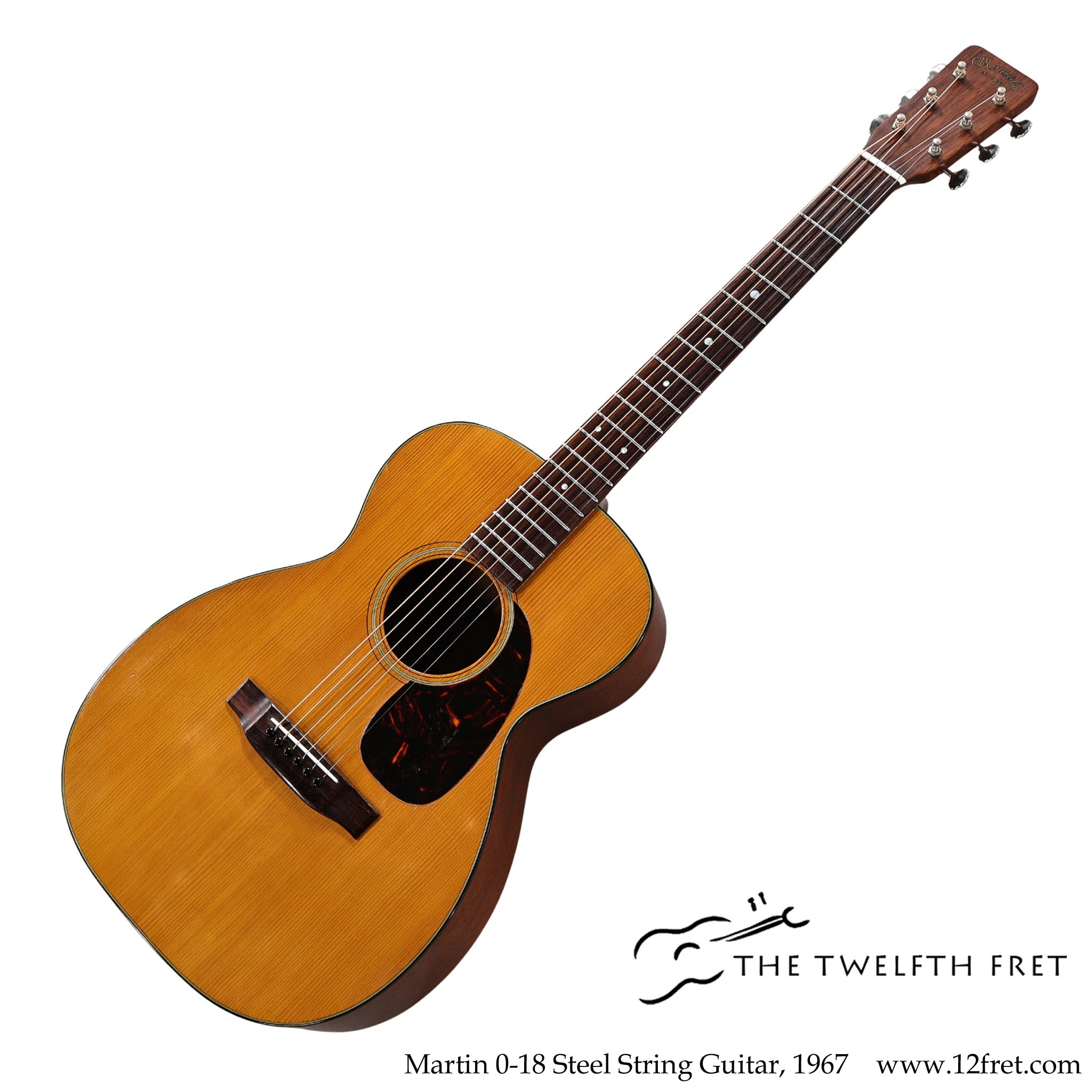
Here we’re looking at a Martin 0-18 steel string guitar built late 1967, perhaps November, at the Martin plant in Nazareth, Pennsylvania. This lovely instrument has been recently serviced with a neck reset at The Twelfth Fret Repair Shop.
This Martin 0-18 is in overall good shape with one expected crack, the common Martin pickguard split that occurred because the pickguard was until 1984 glued directly to the top, with finish applied over top. Over time, the materials used for the pickguards shrank at different rates than the wood, and if the glue didn’t fail, the top would split somewhere between the bridge and the pickguard. These cracks are very common on vintage Martins (and Gibsons!) and do not reduce the structural integrity of the top.
Construction and Materials
This Martin 0-18 uses Martin's smallest and oldest production body size, the '0', often called 'single 0'. And yes, it's a zero, not a letter! The 0 body size is slightly larger than the 'Parlor' style.
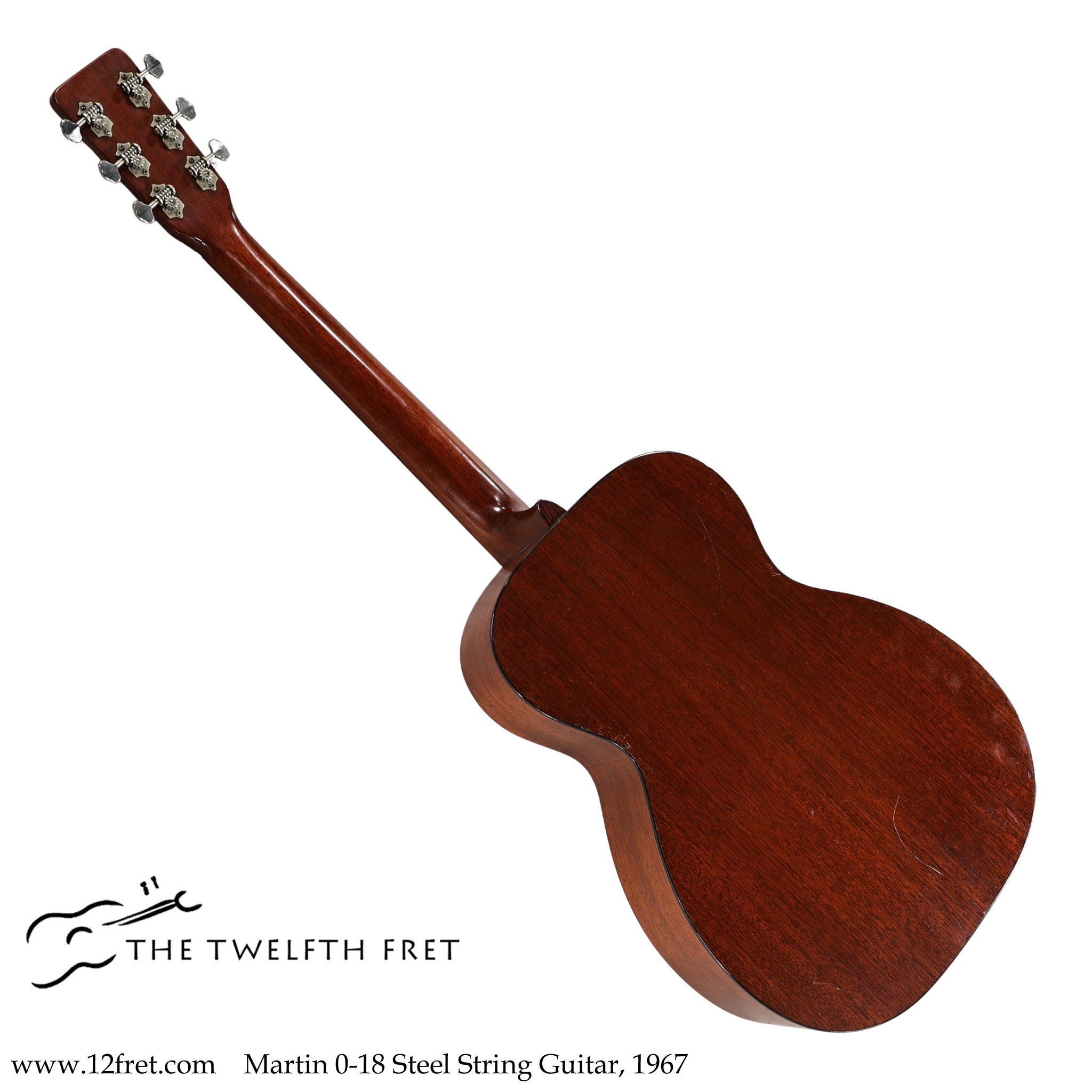
As a Style 18 model, this Martin 0-18 pairs a Sitka Spruce top with Honduran Mahogany for the sides, back, body blocks linings and neck. The fingerboard, bridge and headplate are Rosewood and in 1967 specifically Brazilian Rosewood. When the Brazilian restrictions on Rosewood exports came into force in the mid 1960s, Martin still had large stocks, finally running out around 1969 though there are a few guitars into the very early 70's with some Brazilian. Other companies, led by Fender shifted to other materials, particularly Indian Rosewood starting around 1966.
For hardware, the tuners are standard open-gear Grover Sta-Tite models that have been popular since the 1930s.
Over decades, virtually all steel string guitars will ‘settle’ under tension and ultimately require a neck reset. That has just been done on this Martin 0-18. Consequently, this example is fully playable and ready to go for many more years!
Model History
Introduced in 1898, discontinued in 1996 and reissued in 2017, the Martin 0-18 is one of the oldest, longest produced guitar designs. It hasn’t changed much over the decades. In 1934 the most notable change occurred with the shift to the 14-fret neck, following the lead of the then-recently introduced OM or Orchestra Model. The next change was in 1947 with the use of Rosewood instead of Ebony for the fingerboard and bridge. At the time and ending in 1969, that meant Brazilian Rosewood. For top woods, until the early 1940’s Adirondack Spruce was the wood of choice, but wartime demands on that species caused a shift to Sitka Spruce.

|
There are no refunds or returns on used items unless authorized in advance by a Twelfth Fret Sales Associate at time of sale. View Our Full Terms Here |
DETAILS:
- Instrument Model: 0-18
- Instrument Manufacturer: Martin
- Instrument year: 1967
- Instrument Finish: Gloss Natural Nitrocellulose Lacquer
- Instrument Class: Steel String Acoustic Guitars
- Instrument serial number: 218319, built late 1967 at Nazareth PA
- Country of Origin: USA
- Instrument Condition: Very Good
- Right-handed
- CITIES Documentation Required: Yes
- Case included: Yes
- Case original: No
- Case Type: Hard Shell
- Instrument Weight Imperial: 3.344 lbs
- Instrument Weight Metric: 1.52 kgs
- Scale Length Imperial: 24.9 in
- Scale Length Metric: 632 mm
- Nut Width Imperial: 1.678 in
-
Nut Width Metric: 42.64 mm
- Items in Case: N/A
- Consignment: Yes
- Product ID: 190631
|
|
There are no refunds or returns on used items unless authorized in advance by a Twelfth Fret Sales Associate at time of sale. View Our Full Terms Here |